
How Jesus turned Nicodemus’ Worldview Upside Down
Nicodemus’ encounter with Jesus in John 3:1–21 highlights the tension between faith and works that has existed since the Garden of Eden. This conversation between Jesus and Nicodemus still raises one of the most important questions for believers today: What role do faith and works play in salvation?
In Jesus’ day, the Jewish religion had become largely works-oriented. They had finally recognized that obedience to all God’s instructions was critical to their nation’s welfare.
Unfortunately, their focus turned to obeying the letter of the law rather than living by faith.
They developed a checklist of dos and don’ts that everyone was expected to follow. Salvation, they believed, was earned by behavior, circumcision, and temple services. This mindset completely distorted their understanding of the character of God, transforming Him from a loving Savior into an exacting taskmaster. As a result, it never occurred to them that they needed to be saved from their sins. Instead, what they longed for was salvation from Roman tyranny.
When Nicodemus joined Jesus for that fateful, clandestine interview, he came confident of his place in heaven. But when Jesus told him he needed to be born again through baptism and the indwelling of the Holy Spirit, he was flabbergasted. In one sweeping statement, Jesus reduced this highly educated, well-respected member of the Sanhedrin—the Pharisee of Pharisees—to the level of a common sinner who needed to repent and be baptized. This was not only shocking, but offensive.
But Jesus didn’t stop there. He emphasized that salvation came only through faith in His own death on the cross. Period. No caveats.
Just as the Israelites had to exercise faith by looking at the bronze serpent lifted up on a pole to be healed from deadly snakebites and receive life again (Numbers 21:4–9), so we must exercise faith by looking to Christ lifted up on the cross to be healed from sin and receive eternal life (John 3:14–15).
The Bible is crystal clear that nothing we do can earn salvation. It is a gift from God (Ephesians 2:8–9; Romans 6:23; John 3:16).
Does Faith Cancel the Need for Obedience? What the Bible Says About Faith and Works
Was Jesus then teaching that obedience—or what most call works—was unnecessary for the Christian life?
Not if you read the entire interview, especially verses 19–21:
“And this is the judgment: the light has come into the world, and people loved the darkness rather than the light because their works were evil. For everyone who does wicked things hates the light and does not come to the light, lest his works should be exposed. But whoever does what is true comes to the light, so that it may be clearly seen that his works have been carried out in God.”
John 1:4–9 identifies Jesus as the Light of the World in language very similar to the passage above. David referred to Scripture as a lamp for our feet and a light for our path (Psalm 119:105), and Jesus stated that the Scriptures testified of Him (John 5:39). Accordingly, the “light” Jesus refers to is both Himself and the Scriptures.
And here is where it gets interesting for the discussion of faith and works in salvation.
Those who live in disobedience, who continue practicing sin, hate the light and refuse to come to it because it exposes their sins. The only people who love God’s light are the ones who want to live in obedience to it—who long to put away sin and do what is right.
The Difference Between Pharisaical Works and True Obedience
A crucial difference exists, however, between their obedience and that of the Pharisees. Those who love God’s light and step into it allow that light to reveal how God Himself empowers them to carry out their righteous deeds (John 3:21 NKJV).
In other words, without God working in us, we are incapable of producing the kind of good works that everyone recognizes as truly godly.
Jesus clarified this difference in John 14:15 when He said, “If you love Me, keep My commandments.”
This puts obedience in an entirely different light.
Obedience (or works) doesn’t earn salvation. Jesus made this clear when He told Nicodemus—a highly educated, law-abiding, circumcised Pharisee—that he needed to be born again.
Obedience also doesn’t earn God’s love. God’s love for us is eternal and unshakable, evidenced by the fact that even before He created the world, the Trinity had already formed the plan of redemption through the death of Jesus (1 Peter 1:20; Revelation 13:8). In reality, Jesus came to save us while we were still sinners (Romans 5:8). He loved us first, not the other way around (1 John 4:19).
Why Good Works Matter in Salvation: Faith and Obedience in the Bible
Our good works simply reveal our love for God. If we truly love Jesus, we will not want to do anything that would wound His heart—just as our love for our children or spouse inspires us to avoid actions that would hurt them.
Sin wounds God. The life and death of Jesus are proof of that. He was maligned, hated, rejected, abandoned, abused, humiliated, tortured, and finally crucified—all because everything He was and taught exposed humanity’s love for sin.
Those who prefer to continue in sin cannot live comfortably in the presence of God.
Therefore, if we love Jesus and desire to live in relationship with Him, we will choose to do what is right—not out of obligation but out of love, because we cannot bear to hurt Him or be separated from Him.
Sin always separates God’s people from Him and blocks His protection, provision, intervention… His salvation. You cannot read the Old Testament prophets without hearing God’s desperate pleading with His people to repent and return to Him so He could save them and heal them of their sins.
Jesus’ death provided the way for us to be forgiven of our sins and become partakers of His divine nature again (2 Peter 1:4), enabling us to overcome sin. He did not die to give us permission to continue in it.
Jesus accepts us just as we are when we come to Him. But just as He told the woman caught in adultery, He also tells us, “Go and sin no more” (John 8:11).
Faith Without Works Is Dead
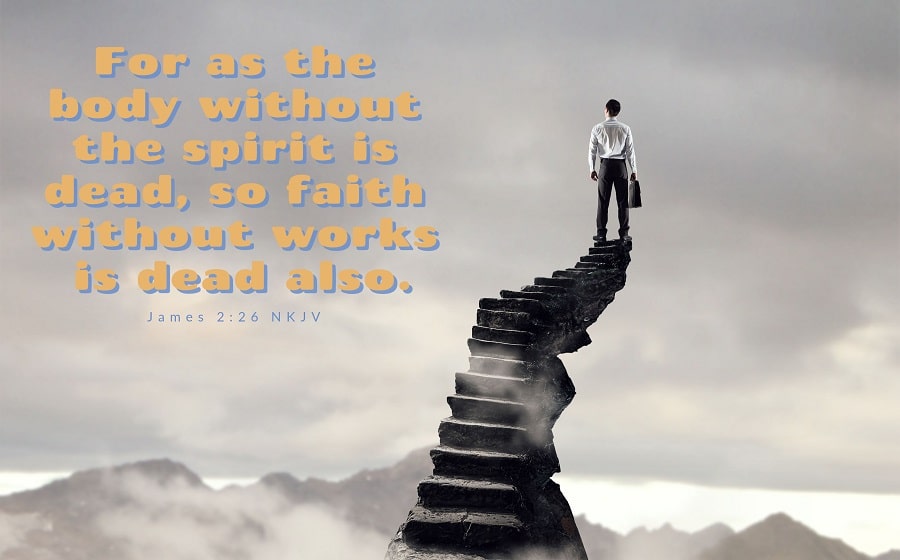
James 2:14–26 contains an in-depth discussion of the relationship between faith and works in the Bible. But the crux of the matter is summed up in verse 26:
“For as the body without the spirit (breath) is dead, so faith without works is dead also.”
Just as we cannot live without breathing, faith cannot live without obedience. Our faith in Jesus’ death and resurrection to save us from sin and give us eternal life is evidenced by our obedience to His word. You cannot have one without the other and still be saved.
That is why the Hall of Faith in Hebrews 11 clearly shows the connection between the patriarchs’ faith and their obedience.
Abel had faith in God’s promise that He would provide a Savior, so he obeyed and offered the lamb as a sacrifice just as God instructed. If Abel had believed in God’s promise but refused to offer the lamb, he would have been no better than Cain, and it would have availed him nothing (Hebrews 11:4).
Noah had faith in God’s word, so he obeyed and built the ark. If Noah had believed God but never acted, he and his family would not have been saved (Hebrews 11:7).
Abraham had faith that God would give him and his descendants a country, so he left Ur to journey to an unknown land. If Abraham had professed faith but never left Ur, his faith would have been worthless (Hebrews 11:8–10).
Faith without obedience is worthless, just as obedience without faith is pointless.
You cannot have one without the other and genuinely love God or desire His presence. They are two sides of the same coin—inseparable.
How God Empowers Faith and Works Through His Spirit
The astounding good news, however, is that when we come into the light, into a relationship with Jesus, He works in us to accomplish good works (Philippians 2:12–13). That is why Paul could declare, “I can do all things through Christ who strengthens me” (Philippians 4:13 NKJV). And Jesus Himself promised:
“Come to me, all who labor and are heavy laden, and I will give you rest. Take my yoke upon you, and learn from me, for I am gentle and lowly in heart, and you will find rest for your souls.” (Matthew 11:28–29)
Obedience is not drudgery because Jesus is in the yoke with us, doing the heavy lifting. Obedience becomes an act of love, powered by faith in Jesus.
***Unless otherwise noted, all Bible quotes are from the English Standard Version.
0 Comments